
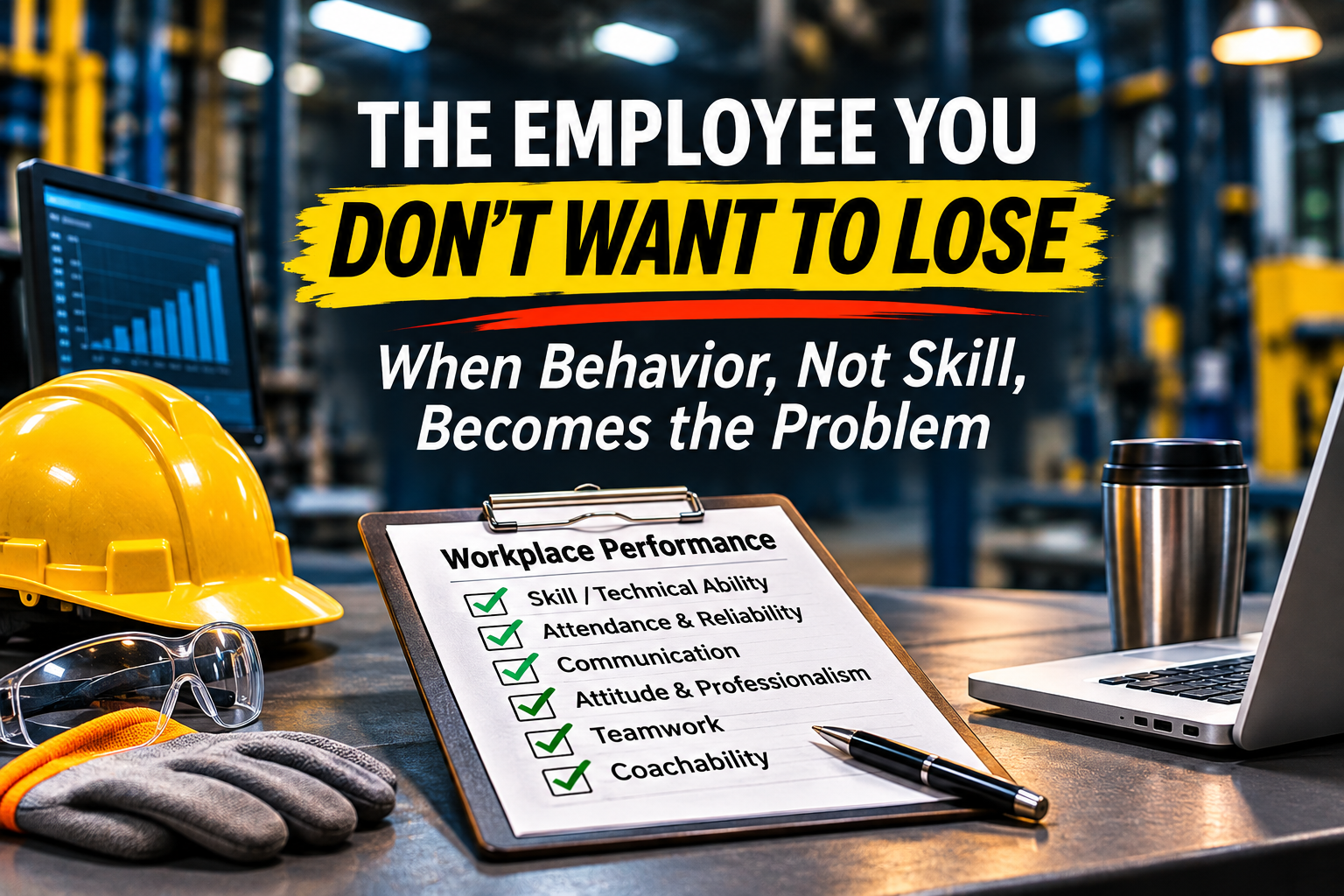
A supervisor has an employee who knows the job.
The employee may have years of experience. Productivity may be good. Technical knowledge may be strong. When something difficult needs to get done, this may even be one of the people management depends on.
But there is a problem.
The employee is frequently late. Or becomes defensive when corrected. Perhaps communication with coworkers is poor. Maybe attitude changes whenever something does not go as expected. The employee may resist procedures, challenge supervision, create unnecessary conflict, or simply be inconsistent.
Management eventually finds itself asking a difficult question:
How do we handle an employee we don’t want to lose—but whose behavior is becoming increasingly difficult to accept?
This is where the difference between job skill and workplace readiness becomes important.
Technical Ability Is Only Part of Employee Value
Organizations understandably concentrate heavily on technical qualifications when hiring.
Can the candidate perform the work?
Does the person have the required education, certification, experience, or technical ability?
Those questions are necessary. But they don’t tell the entire story.
Once an employee enters the workplace, employers begin evaluating characteristics that may have been much harder to identify during an interview:
- Is the employee dependable?
- Does the employee communicate professionally?
- Can the employee accept correction?
- Does the employee follow established procedures?
- How does the employee respond under pressure?
- Can supervisors rely on the employee consistently?
- Does the employee contribute to—or disrupt—the team?
An employee can be technically excellent and still create serious operational problems through behavior.
That creates a particularly difficult management challenge because replacing a skilled employee has consequences too.
The Cost of the Behavior-Skill Gap
When management tolerates poor behavior because an employee is technically valuable, the cost can spread beyond that individual.
Coworkers notice when standards are applied inconsistently.
Supervisors spend additional time managing problems that should not exist.
Communication deteriorates.
Morale can decline.
Other employees may have to compensate for attendance, reliability, teamwork, or accountability problems.
Eventually, an organization may find itself protecting the technical contribution of one employee while unintentionally allowing that employee’s behavior to affect the performance of several others.
The problem is no longer simply an employee problem.
It has become an operational problem.
The Operations Manager’s Reality: Development Competes With Production
This is where the situation becomes especially difficult for an operations manager.
The manager may clearly recognize the behavioral problem.
The manager may coach the employee, explain expectations, provide feedback, document concerns, and genuinely attempt to help a technically valuable employee improve.
But the manager is also responsible for the operation.
Production must continue. Customers must be served. Quality and safety requirements must be maintained. Schedules must be met. Other employees require supervision. Problems throughout the operation still have to be solved.
There is only so much management time available.
When the same employee repeatedly requires intervention for attendance, attitude, communication, conflict, resistance to direction, or accountability, the manager can eventually spend a disproportionate amount of time managing behavior instead of managing the operation.
That creates another cost that may not appear immediately on a financial statement:
management attention.
At some point, the question changes from:
“Can this employee improve?”
to:
“How much longer can the operation afford to wait for the improvement?”
Those are very different questions.
A manager may believe an employee has the ability to change and may even want to retain that employee. But operational requirements do not always provide unlimited time for behavioral development.
Sometimes a staffing change, reassignment, disciplinary action, or separation may become necessary despite the employee’s technical value.
That does not necessarily mean management failed to recognize the employee’s potential.
It may simply mean the operation could no longer absorb the consequences while waiting for that potential to become consistent behavior.
Before Losing the Employee, Identify the Real Problem
When operational circumstances allow, there is an important question to ask before reaching that point:
Is the behavior identifiable, coachable, and correctable?
Consider the difference between an employee who does not understand an expectation and an employee who understands it but refuses to meet it.
Those are not the same problem.
An employee who is willing to listen, accept responsibility, make adjustments, and demonstrate improvement may be worth developing—particularly when that employee already possesses valuable technical skills and organizational knowledge.
This is where structured behavioral development can make a difference.
Instead of simply saying:
“Improve your attitude.”
“Communicate better.”
“Be more professional.”
“Become more dependable.”
Management can identify the specific behaviors that need to change, explain why they matter, establish expectations, and evaluate whether improvement actually occurs.
Common sense becomes more powerful when it is structured, connected, and applied.
Coachability Matters — But So Does Time
Not every employee will respond to development.
And even employees who are capable of improving may not improve quickly enough to meet the needs of the operation.
That distinction matters.
Workplace readiness cannot simply be imposed on someone who has no interest in changing. An employee must be willing to examine personal behavior, accept appropriate feedback, and make adjustments.
Consider two technically capable employees with the same behavioral problem.
One says:
“I understand the concern. What do I need to change?”
The other says:
“That’s just how I am. If they don’t like it, that’s their problem.”
The technical skill may be identical.
The long-term employment potential probably is not.
But willingness must eventually be followed by action.
An employee who repeatedly says, “I’ll do better,” without producing sustained behavioral improvement can create the same operational burden as an employee who openly resists change.
For the operations manager, intent matters—but consistent improvement matters more.
Correct Behavior Before It Becomes a Separation Decision
This is precisely why behavioral preparation should begin earlier.
Organizations often wait until behavioral problems have become disciplinary problems before addressing them seriously.
By that point, frustration may already exist on both sides.
The employee may feel targeted.
The supervisor may have lost patience.
Coworkers may already be affected.
Human Resources may be dealing with a situation that could have been easier to address earlier.
And the operations manager may no longer have the luxury of additional development time.
Workplace-readiness development should not begin only when someone is about to lose a job.
It should begin before Day One and continue throughout employment.
Employees benefit from understanding early that getting hired is only the beginning.
Getting hired opens the door. Workplace readiness helps you stay, succeed, and grow.
Employers benefit when those expectations are understood before behavioral problems become entrenched and operational productivity forces a more difficult decision.
A Management Question Worth Asking
When a technically capable employee begins struggling behaviorally, management should ask more than:
“Should we keep this employee?”
A better sequence of questions may be:
What specific behavior is creating the problem?
Has the expectation been clearly communicated?
Does the employee understand how the behavior affects coworkers, customers, supervisors, or operations?
Has the employee been given a reasonable opportunity to correct it?
Is measurable improvement actually occurring?
How much management time is the problem consuming?
And most importantly:
Does the employee WANT to improve—and is that willingness becoming visible through behavior?
If the answer is yes, there may still be significant value worth developing.
If the answer repeatedly becomes no—or improvement does not occur within a timeframe the operation can reasonably sustain—technical ability alone may eventually be insufficient.
The RDS Perspective
At Rayford Dynamic Services, we believe workplace readiness deserves greater attention before employment problems develop.
Technical skills help individuals qualify for opportunities.
Workplace behaviors help them succeed once those opportunities are received.
Reliability. Communication. Accountability. Professionalism. Emotional control. Safety awareness. Teamwork. Coachability.
None of these replaces technical competence.
They strengthen it.
For employers, HR professionals, staffing organizations, workforce-development programs, and employees themselves, the opportunity is to stop treating these behaviors as vague expectations and begin developing them as recognizable workplace competencies.
Because sometimes the employee you don’t want to lose doesn’t need another technical class.
They need the willingness—and the structure—to become as strong behaviorally as they already are technically.
And the best time to begin developing that readiness is before an operations manager is forced to choose between an employee’s potential and the needs of the operation.